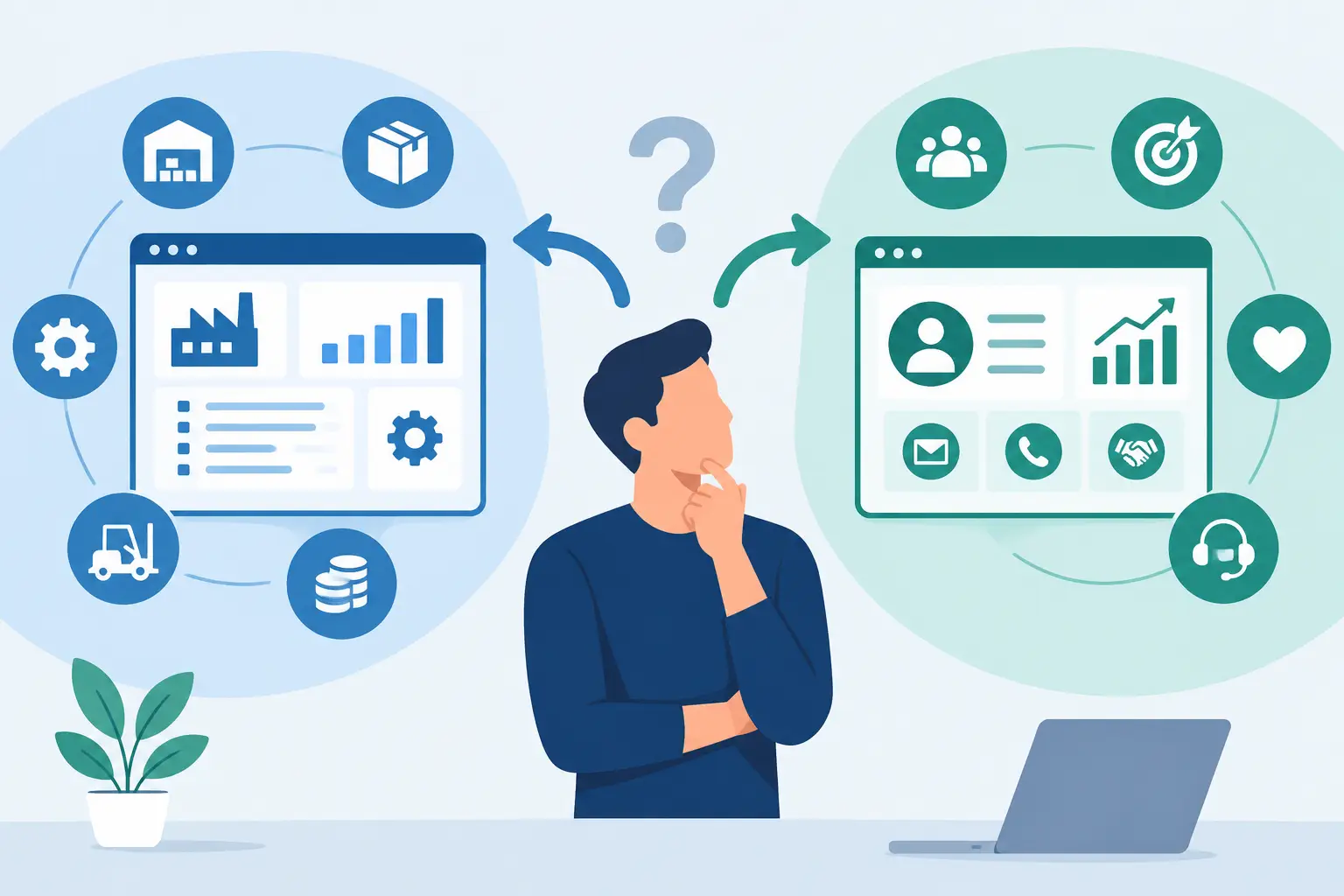
If your sales team tracks follow-ups in one tool, operations manages tasks in another, and admin still chases approvals by email, the problem is not just software sprawl. It is process friction. A crm su misura per processi aziendali solves that friction by adapting the system to how work actually moves across your company - from first contact to quote, approval, execution, and renewal.
That distinction matters more than many businesses expect. A standard CRM can store contacts and opportunities. But when your daily work includes custom quote flows, internal handoffs, recurring activities, document collection, signatures, and status-dependent actions, a generic setup quickly becomes a workaround machine. Teams start compensating with spreadsheets, chat messages, and manual reminders. Visibility drops, response times stretch, and small operational gaps turn into missed revenue or preventable delays.
Why a CRM su misura per processi aziendali changes results
Most companies do not need more software. They need fewer interruptions between one step and the next. A CRM built around your processes creates that continuity.
In practical terms, this means the platform does more than record customer data. It reflects the real sequence of work inside your business. A lead enters the system, gets assigned based on defined rules, triggers follow-up tasks, generates a quote with the right fields, routes approvals to the correct people, stores documents in context, and keeps everyone aligned on the current status.
The value is operational before it is technical. Teams know what to do next. Managers can see where deals or requests are slowing down. Administrative work stops living outside the core workflow. Instead of asking people to remember every step, the process itself carries the work forward.
This is especially relevant for small and mid-sized businesses that have grown beyond simple contact management but are not willing to invest in heavy enterprise systems. They need control, speed, and adaptability without creating a second job around software maintenance.
Standard CRM vs CRM su misura per processi aziendali
The difference is not cosmetic. It affects adoption, data quality, and execution.
A standard CRM usually starts from a fixed idea of pipeline management. That works well when your commercial process is linear and your operational needs are limited. If your team mainly needs to manage leads, calls, and a short sales cycle, a traditional model may be enough.
But many organizations operate with more complexity. A construction firm may need site-specific data, quote revisions, approval checkpoints, and document traceability. A consulting practice may need recurring tasks, client onboarding steps, signed proposals, and deadline-based reminders. A hospitality business may manage requests, commercial proposals, internal coordination, and post-sale activities across several functions.
In these cases, the issue is not whether the CRM has many features. The issue is whether those features can be configured around your workflow. Custom fields, tailored statuses, role-based views, and rule-driven automations are what make the system useful day after day. Without them, the team ends up bending its process to fit the tool. That is usually where adoption starts to break.
What to look for in a CRM built around real workflows
A useful CRM for operationally complex businesses needs to support execution, not just reporting. That starts with configurability.
Custom fields matter because each business tracks different variables. If your team needs to record contract types, installation dates, renewal conditions, property details, internal margins, or compliance notes, those data points must be native to the workflow, not hidden in free-text notes.
Configurable flows matter because every company has decision points. A quote may require technical validation before it goes out. A signed proposal may need to trigger a task for operations. A missing document may need to block the next step until it is uploaded. A crm su misura per processi aziendali should support these conditions cleanly.
Automation also needs to be practical. Good automation does not exist to impress. It exists to remove repetitive steps that steal time from revenue-generating and client-facing work. Assignment rules, reminders, deadline alerts, document requests, quote generation, status updates, and approval notifications all reduce the amount of manual coordination required.
Then there is visibility. One of the biggest costs of fragmented tools is that no one sees the whole process. Sales sees the opportunity, admin sees the paperwork, operations sees the delivery task, and leadership sees only partial reports. A unified system creates a shared operational picture. That improves decision-making, but even more importantly, it reduces confusion during execution.
Where customization creates the most business value
Not every company needs the same level of tailoring. The best approach is to identify where process variability affects performance.
For some businesses, the biggest gain is in quote management. If proposals are still assembled manually, passed around by email, then re-entered into another system after approval, delays are almost guaranteed. A customized CRM can standardize quote creation, connect templates to client records, route internal approvals, and move the deal forward once the customer accepts.
For others, the bottleneck is task coordination. A deal closes, but the handoff to operations depends on someone sending the right message to the right people. That works until volume increases. Building tasks, checklists, deadlines, and dependencies into the same workflow removes that reliance on memory.
Document-heavy companies often see value even faster. If contracts, signed forms, attachments, and client communications are scattered across inboxes and shared folders, every exception creates more administrative effort. Centralizing those elements inside the CRM reduces search time and helps maintain a cleaner audit trail.
There is also a compliance angle. For companies handling regulated data, sensitive documents, or signature-dependent workflows, customization must coexist with trust. Data location, GDPR alignment, and eIDAS-compliant electronic signatures are not side issues. They directly affect how safely and credibly the process can run.
The role of modularity in a CRM su misura per processi aziendali
One common concern is overbuilding. Many businesses know they need a better system, but they do not want to pay for a full software ecosystem on day one.
That is where a modular model makes sense. You start with a CRM core that organizes customer data, commercial activity, and process visibility. Then you activate additional functions only where they create immediate operational value - task management, quote workflows, document handling, signatures, automations, or AI assistance.
This approach is more sustainable than buying a rigid all-in-one suite and using 20 percent of it. It also avoids the opposite mistake: stacking disconnected point tools every time a new need appears. Modularity works when the modules still belong to one operational environment and share the same data logic.
For growing companies, that matters. Your current process may be manageable with a small team and a few manual steps. Six months later, those same steps become bottlenecks. A system that can expand without forcing a platform replacement protects both continuity and investment.
AI is useful when it supports execution
AI in business software is often presented as a headline feature. For most companies, that is not enough. What matters is whether AI helps the team move faster and with fewer errors.
Inside a process-driven CRM, AI should act like a working companion. It can support content drafting, summarize interactions, assist with routine communication, help classify requests, and reduce the time spent on repetitive administrative actions. The benefit is not novelty. The benefit is throughput.
That said, AI is not a replacement for process design. If the workflow is unclear, automating confusion only makes it faster. The strongest results come when AI sits on top of a well-structured operational model with clear statuses, reliable data, and defined responsibilities.
When a tailored CRM is the right move
A custom-fit CRM is not necessary for every business. If your process is simple, your team is small, and your current setup is genuinely under control, a lighter system may still be enough.
But if work regularly disappears between departments, if reporting depends on manual updates, if quotes and approvals create delays, or if your team keeps building side processes outside the CRM, the cost of staying with a generic tool is already showing up in daily operations.
That is usually the signal to rethink the system around the business, not the other way around. Platforms like Processi.Cloud are built for that reality: a CRM foundation combined with modular operational tools, configurable workflows, AI support, and compliance-oriented features that fit how modern companies actually run.
The right CRM should not ask your team to become software experts just to get basic work done. It should make execution clearer, faster, and easier to control - especially when your processes are what make your business competitive.